
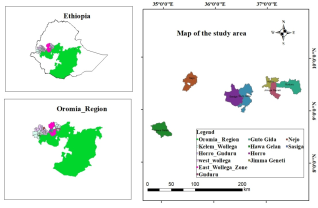
One of the main reasons for poor soil fertility status of acidic soils is low content of soil available plant nutrients like N, P, S, exchangeable Ca and Mg and toxicity of Al and Fe resulted from low soil pH value. Amendment of acidic soil using organic sources like compost is very crucial for improving the livelihood of the society through increasing crop productivity. Therefore, this study was conducted to assess the nutrient content and quality of compost prepared at farmers‘ level and guiding the integrated use of both chemical and organic fertilizers approach sustainably. The compost samples were collected from seven districts, namely Guto-Gida, Sassiga, Guduru, Horo, Jima-Genet, Hawa-Gelan and Nedjo, in western Oromia Regional State. The composts were prepared at farmers’ level from the locally available composting materials. The composting materials used were more or less similar in all districts except it might vary in one or two sources which were used at very low ratio compared to the main sources. The result of the compost nutrient content revealed that the mean values of EC, pH, TN and C:N ratio ranged from 1.22 to 1.99 mmhos/cm, 7.25 to 8.20, 0.45 to 0.74% and 11.51 to 12.65, respectively which fell within the acceptable range for good quality compost. On the other hand, the mean values of OC, available P, exchangeable Ca and Mg were ranged from 5.19 to 7.83%, 0.006 to 0.013%, 44.79 to 83.72 mg kg soil–1 and 1.40 to 8.61 mg kg compost–1, respectively which fell below the acceptable range for good quality compost. Based on the crucial parameters indicating good quality compost like pH and C:N ratio the compost prepared from the locally available composting materials by the farmers were for improving the overall quality of the soil. Hence, productivity of crops would increased by using compost as source of organic fertilizers from which farmers in the study area benefited sustainably.
| Published in | Science Journal of Analytical Chemistry (Volume 14, Issue 1) |
| DOI | 10.11648/j.sjac.20261401.12 |
| Page(s) | 10-17 |
| Creative Commons |
This is an Open Access article, distributed under the terms of the Creative Commons Attribution 4.0 International License (http://creativecommons.org/licenses/by/4.0/), which permits unrestricted use, distribution and reproduction in any medium or format, provided the original work is properly cited. |
| Copyright |
Copyright © The Author(s), 2026. Published by Science Publishing Group |
Compost, Quality Compost, Acceptable Range, Locally Available, Organic Fertilizer
Zone | District | Materials used | Remark |
|---|---|---|---|
East Wollega | Guto-Gida | Fresh cow dung, top soil, ash and maize stalk | |
Sassiga | Fresh cow dung, topsoil, ash, maize stalk and leaves of pumpkin, | ||
Horo-Guduru Wollega | Guduru | Fresh cow dung, topsoil, ash, maize stalk and different weed species | |
Horro | Fresh cow dung, topsoil, ash and maize stalk | ||
Jima-Genet | Fresh cow dung, top soil, ash, maize stalk and different weed species | ||
Kellam Wollega | Hawa-Gelan | Fresh cow dung, topsoil, ash, maize stalk and leaves of pumpkin | |
West Wollega | Nedjo | Fresh cow dung, topsoil, ash, maize stalk and different weeds species |
Descriptive Statics | District | ||||||
|---|---|---|---|---|---|---|---|
Guto-Gida | Sassiga | Guduru | Horo | Jimma-Genet | Hawa-Gelan | Nedjo | |
Composts’ Electrical conductivity (mmhos/cm) | |||||||
N | 27 | 24 | 16 | 9 | 10 | 19 | 41 |
Mean | 1.12 | 1.73 | 1.92 | 1.40 | 1.65 | 1.99 | 1.86 |
Minimum | 0.29 | 0.06 | 0.68 | 3.90 | 0.73 | 0.29 | 0.34 |
Maximum | 3.99 | 6.33 | 7.07 | 9.00 | 3.69 | 8.49 | 6.03 |
pH(1:2.5H2O) | |||||||
Mean | 7.63 | 7.53 | 8.04 | 7.25 | 7.90 | 7.90 | 8.21 |
Minimum | 6.50 | 5.95 | 6.65 | 8.75 | 6.39 | 5.73 | 6.45 |
Maximum | 8.78 | 8.55 | 9.19 | 9.00 | 9.18 | 9.15 | 9.69 |
P (mg kg-1) | |||||||
Mean | 92.29 | 60.14 | 84.79 | 73.74 | 99.86 | 130.96 | NV |
Minimum | 50.22 | 12.30 | 40.86 | 110.41 | 58.81 | 41.14 | NV |
Maximum | 136.52 | 137.82 | 132.05 | 9.00 | 146.08 | 156.55 | NV |
OC (%) | |||||||
Mean | 7.83 | 7.17 | 6.79 | 8.58 | 7.25 | 5.19 | 6.38 |
Minimum | 3.81 | 3.12 | 4.65 | 12.09 | 4.95 | 2.86 | 3.41 |
Maximum | 13.37 | 15.45 | 9.17 | 9.00 | 12.60 | 8.37 | 12.79 |
TN(%) | |||||||
Mean | 0.67 | 0.62 | 0.59 | 0.74 | 0.63 | 0.45 | 0.55 |
Minimum | 0.33 | 0.27 | 0.13 | 1.04 | 0.43 | 0.25 | 0.29 |
Maximum | 1.15 | 1.33 | 0.27 | 0.40 | 1.09 | 0.72 | 1..03 |
C:N ratio | |||||||
Mean | 11.69 | 11.56 | 11.51 | 11.59 | 11.51 | 11.53 | 11.60 |
Maximum | 11.63 | 11.62 | 33.96 | 22.5 | 11.60 | 11.63 | 12.42 |
Minimum | 11.55 | 11.56 | 35.76 | 11.63 | 11.52 | 11.44 | 11.58 |
Ca (mg kg-1) | |||||||
Mean | 79.99 | 71.88 | 83.72 | 47.87 | 44.79 | 61.00 | NV |
Minimum | 39.13 | 21.41 | 8.60 | 78.99 | 18.26 | 41.86 | NV |
Maximum | 115.69 | 127.44 | 151.91 | 9.00 | 85.56 | 95.43 | NV |
Mg (mg kg-1) | |||||||
Mean | 8.56 | 8.61 | 7.00 | 1.40 | 5.60 | 8.44 | NV |
Minimum | 3.72 | 2.61 | 0.89 | 3.90 | 1.56 | 6.11 | NV |
Maximum | 14.50 | 13.50 | 12.78 | 9.00 | 12.11 | 12.16 | NV |
AAS | Atomic Absorption Spectrophotometer |
Al | Aluminum |
Ca | Calcium |
C:N | Carbon to Nitrogen ratio |
DTPA | Diethylene triaminepenytaacetic acid |
EC | Electrical Conductivity |
Fe | Iron |
GHG | Green House Gas |
Mg | Magnesium |
OC | Organic CarboN |
OM | Organic Matter |
P | Phosphorus |
S | Sulfur |
TN | Total Nitrogen |
| [1] | Gashaw T, Bantider A, Gebresilassie H. Land degradation in Ethiopia: Causes, impacts and rehabilitation techniques. Journal of Environmental Earth and Sciences, 2014; 4(9): 98-104. |
| [2] | Sutton M, Howard C, Erisman J, Billen J, Bleeker A, Grizzetti B. The European nitrogen assessment, sources, effects and policy perspectives. 2011. |
| [3] | Agegneh G, van-Beek C. Bird M. Influence of integrated soil fertility management in wheat and tef productivity and soil chemical properties in the highland tropical environment. Journal of Soil Science and Plant Nutrition, 2014; 532-545. |
| [4] | Fageria N, Baligar V. Ameliorating soil acidity of tropical Oxisols by liming for sustainable crop production. Advances in Agronomy, 2008; 99:345-399. |
| [5] | IFPRI (International Food Policy Research Institute). Fertilizer and soil fertility potential in Ethiopia, Constraints and opportunities for enhancing the system, working paper. 2010. |
| [6] |
Våje P. Bationo A, Waswa B, Kihara J, Kimetu J (eds.). Advances in integrated soil fertility management in Sub-Saharan Africa: Chanllenges and opportunities. Springer, Netherand. 2007.
https://library.au.int/fradvances-integrated soil fertility-management sub-saharan-africa-challenges-and-opportunities |
| [7] | Ganjali H, Mobasser H, Esmaielzehi A, Tavassoli A. Effect of organic compost on yield and protien content of corn cultivars in Khash region. Journal of Novel Applied Sciences, 2013; 2: 369-374. |
| [8] | Sreenivas C. Muralidhar G, Rao M. Vermicomposts: a viable component of IPNSS in nitrogen nutrition of ridge gourd. Annals of Agricultural Research, 2000; 21(1): 108-113. |
| [9] | Amlinger F, Peyr S, Geszti J, Dreher P, Weinfurtner K, et al. Beneficial effects of compost application on fertility and productivity of soils. Federal Ministry for Agriculture and Forestry, Environment and Water Management, Austria. 2007. |
| [10] | Rader H. The compost heap: Basic composting in Alaska. University of Alaska Fairbanks, Alaska. 2013. |
| [11] | Chen L, Marti M, Moore A, Falen C. The composting process: Dairy compost production and use in Idaho. 2011. |
| [12] | Christian A, Evanylo G, Pease J. On-farm composting: A guide to principles, planning and operations. Virginia Cooperative Extension, VirginiaTech, Virginia State University, Petersburg. 2009. |
| [13] |
TMECC (Test Methods for the Examination of Composting and Compost). A manual: a collaborative effort by the United State Department of Agriculture (USDA) and the United State Composting Council (USCC) 2001a.
https://compostingcouncil.org/tmecc/ (verified 17 Aug 2018). |
| [14] | Gajalakshmi S. Abbasi S. Solid waste management by composting: state of the art, Crit. Reviews in Environmental Sciences and Technology, 2008; 38: 311-400, |
| [15] | El Fels L. Zamama M. Asli A., Hafidi M. Assessment of biotransformation of organic matter during co-composting of sewage sludge-ligno-celullosic waste by chemical, FTIR analyses, and phytotoxicity tests. International Bio-deterioration and Biodegradation, 2014; 87128-137. |
| [16] | Ozkaraova G, Bekb¨olet M. Zinc release by humic and fulvic acid as influenced by pH, complexation and DOC sorption, Geoderma, 2010; 159:131-138, |
| [17] | Sage Publications, Compost Can Turn Agricultural Soil into Carbon Sink. Thus Protecting against Climate Change. ScienceDaily ScienceDaily, 27 February, 2008. |
| [18] | Razza F, D’Avino L. Abate G. Lazzeri L. Designing sustainable technologies, Prod. Pol. 2018; 133-143, |
| [19] | Rasapoor M. Nasrabadi T. Kamali M. Hoveidi H. Waste Management. 2009; 29(2): 570-573. |
| [20] | Jusoh M. L. C, Manaf L. A, Latiff P. A. Composting of Rice Straw with Effective Microorganisms (EM) and Its Influence on Compost Quality. Iranian Journal of Environmental Health Science and Engineering, 2013; 10(1): 1-9. |
| [21] |
Huang G. F, Wong J. W, Wu Q. T, Nagar B. B. Effect of C/N on composting of pig manure with sawdust, Waste Management, 2004; 24: 805-813.
https://doi.org/ 10.1016/j.wasman.2004.03.011 |
| [22] | Makan A, Assobhei O, Mountadar M. Effect of initial moisture content on the in-vessel composting under air pressure of organic fraction of municipal solid waste in morocco. Iranian Journal of Environmental Health, 2012; 10: 3. |
| [23] | Ch’ng H. Y, Ahmed O. H,. Majid N. M. A. Improving phosphorus availability in an acid soil using organic amendments produced from agro-industrial wastes, Scientific World Journal; 2014. |
| [24] | Tumuhairwe JB, Tenywa JS, Otabbong E, Ledin S. Comparison of four low-technology composting methods for market crop waste. Waste Management, 2009; 29: 2274-2281. |
| [25] | Miller R. O. Compost Analysis Proficiency Program. Sample ID: SRC-2015-D (110, 111, 112). 2018. |
| [26] | Medina J, Monreal C, Barea J. M, Arriagada C, Borie F, Cornejo P. Crop residue stabilization and application to agricultural and degraded soils: A review, Waste Management, 2015; 42: 41-54. |
APA Style
Leta, R., Takele, C., Desalegn, M. (2026). Assessing Selected Nutrient Content and Quality of Conventional Composts for Crop Production in Western Oromia, Ethiopia. Science Journal of Analytical Chemistry, 14(1), 10-17. https://doi.org/10.11648/j.sjac.20261401.12
ACS Style
Leta, R.; Takele, C.; Desalegn, M. Assessing Selected Nutrient Content and Quality of Conventional Composts for Crop Production in Western Oromia, Ethiopia. Sci. J. Anal. Chem. 2026, 14(1), 10-17. doi: 10.11648/j.sjac.20261401.12
@article{10.11648/j.sjac.20261401.12,
  author = {Refissa Leta and Chalsissa Takele and Mintesinot Desalegn},
  title = {Assessing Selected Nutrient Content and Quality of Conventional Composts for Crop Production in Western Oromia, Ethiopia},
  journal = {Science Journal of Analytical Chemistry},
  volume = {14},
  number = {1},
  pages = {10-17},
  doi = {10.11648/j.sjac.20261401.12},
  url = {https://doi.org/10.11648/j.sjac.20261401.12},
  eprint = {https://article.sciencepublishinggroup.com/pdf/10.11648.j.sjac.20261401.12},
  abstract = {One of the main reasons for poor soil fertility status of acidic soils is low content of soil available plant nutrients like N, P, S, exchangeable Ca and Mg and toxicity of Al and Fe resulted from low soil pH value. Amendment of acidic soil using organic sources like compost is very crucial for improving the livelihood of the society through increasing crop productivity. Therefore, this study was conducted to assess the nutrient content and quality of compost prepared at farmers‘ level and guiding the integrated use of both chemical and organic fertilizers approach sustainably. The compost samples were collected from seven districts, namely Guto-Gida, Sassiga, Guduru, Horo, Jima-Genet, Hawa-Gelan and Nedjo, in western Oromia Regional State. The composts were prepared at farmers’ level from the locally available composting materials. The composting materials used were more or less similar in all districts except it might vary in one or two sources which were used at very low ratio compared to the main sources. The result of the compost nutrient content revealed that the mean values of EC, pH, TN and C:N ratio ranged from 1.22 to 1.99 mmhos/cm, 7.25 to 8.20, 0.45 to 0.74% and 11.51 to 12.65, respectively which fell within the acceptable range for good quality compost. On the other hand, the mean values of OC, available P, exchangeable Ca and Mg were ranged from 5.19 to 7.83%, 0.006 to 0.013%, 44.79 to 83.72 mg kg soil–1 and 1.40 to 8.61 mg kg compost–1, respectively which fell below the acceptable range for good quality compost. Based on the crucial parameters indicating good quality compost like pH and C:N ratio the compost prepared from the locally available composting materials by the farmers were for improving the overall quality of the soil. Hence, productivity of crops would increased by using compost as source of organic fertilizers from which farmers in the study area benefited sustainably.},
 year = {2026}
}
TY  - JOUR
T1  - Assessing Selected Nutrient Content and Quality of Conventional Composts for Crop Production in Western Oromia, Ethiopia
AU  - Refissa Leta
AU  - Chalsissa Takele
AU  - Mintesinot Desalegn
Y1  - 2026/01/26
PY  - 2026
N1  - https://doi.org/10.11648/j.sjac.20261401.12
DO  - 10.11648/j.sjac.20261401.12
T2  - Science Journal of Analytical Chemistry
JF  - Science Journal of Analytical Chemistry
JO  - Science Journal of Analytical Chemistry
SP  - 10
EP  - 17
PB  - Science Publishing Group
SN  - 2376-8053
UR  - https://doi.org/10.11648/j.sjac.20261401.12
AB  - One of the main reasons for poor soil fertility status of acidic soils is low content of soil available plant nutrients like N, P, S, exchangeable Ca and Mg and toxicity of Al and Fe resulted from low soil pH value. Amendment of acidic soil using organic sources like compost is very crucial for improving the livelihood of the society through increasing crop productivity. Therefore, this study was conducted to assess the nutrient content and quality of compost prepared at farmers‘ level and guiding the integrated use of both chemical and organic fertilizers approach sustainably. The compost samples were collected from seven districts, namely Guto-Gida, Sassiga, Guduru, Horo, Jima-Genet, Hawa-Gelan and Nedjo, in western Oromia Regional State. The composts were prepared at farmers’ level from the locally available composting materials. The composting materials used were more or less similar in all districts except it might vary in one or two sources which were used at very low ratio compared to the main sources. The result of the compost nutrient content revealed that the mean values of EC, pH, TN and C:N ratio ranged from 1.22 to 1.99 mmhos/cm, 7.25 to 8.20, 0.45 to 0.74% and 11.51 to 12.65, respectively which fell within the acceptable range for good quality compost. On the other hand, the mean values of OC, available P, exchangeable Ca and Mg were ranged from 5.19 to 7.83%, 0.006 to 0.013%, 44.79 to 83.72 mg kg soil–1 and 1.40 to 8.61 mg kg compost–1, respectively which fell below the acceptable range for good quality compost. Based on the crucial parameters indicating good quality compost like pH and C:N ratio the compost prepared from the locally available composting materials by the farmers were for improving the overall quality of the soil. Hence, productivity of crops would increased by using compost as source of organic fertilizers from which farmers in the study area benefited sustainably.
VL  - 14
IS  - 1
ER  -
Oromia Agricultural Research Institute, Nekemte Soil Research Centre, Nekemte, Ethiopia
Oromia Agricultural Research Institute, Nekemte Soil Research Centre, Nekemte, Ethiopia
Oromia Agricultural Research Institute, Nekemte Soil Research Centre, Nekemte, Ethiopia




 Share This Article
 Twitter
 Linked In
 Facebook
 Copy
Copy Download