Research Article | | Peer-Reviewed

Electrochemical Investigation of the Ferri/Ferrocyanide Redox Couple on EDTA-Carbon Paste Electrodes

Received: 7 December 2025     Accepted: 12 January 2026     Published: 15 January 2026
Views:       Downloads:
Abstract

This study focuses on evaluating the electrochemical behavior of the ferri/ferrocyanide redox couple [Fe(CN)₆3-/Fe(CN)₆4-] on EDTA-modified carbon paste electrodes, with the aim of developing a sensitive electrochemical sensor for the detection of trivalent and hexavalent chromium Cr(III,VI). EDTA, a complexing agent well known for its strong affinity for metal ions, was incorporated at a concentration of 10% in the carbon paste to enhance the electrode's ion recognition properties. Electrochemical characterization was performed by cyclic voltammetry in the presence of the ferri/ferrocyanide redox couple, used as a probe to assess electron transfer properties. Electrochemical parameters, including the peak potential difference (ΔEp), the anodic and cathodic peak currents (Ipa, Ipc), and their ratio, demonstrated the improved redox behavior and sensitivity of the modified electrode. The observed improvement is likely due to the complexing functional groups of EDTA, which facilitate stronger interactions between the modified electrode surface and the redox species in solution. Electrochemical impedance spectroscopy supports the voltammetric findings, confirming enhanced charge transfer kinetics at the surface of the modified electrode. The results confirm the potential of this configuration as an effective platform for developing reliable and selective electrochemical sensors for detecting Cr(III,VI) in aqueous media. By studying the electrical quantities ΔEp, the formal standard potential E°, and the Ipa/Ipc current ratio, the developed electrochemical sensors can be optimized.

Published in Science Journal of Analytical Chemistry (Volume 14, Issue 1)
DOI 10.11648/j.sjac.20261401.11
Page(s) 1-9
Creative Commons

This is an Open Access article, distributed under the terms of the Creative Commons Attribution 4.0 International License (http://creativecommons.org/licenses/by/4.0/), which permits unrestricted use, distribution and reproduction in any medium or format, provided the original work is properly cited.

Copyright

Copyright © The Author(s), 2026. Published by Science Publishing Group

Keywords

EDTA, Electrochemical, Ferri/Ferrocyanide, Voltammetry, Carbon Paste Electrode

1. Introduction
The development of electrochemical sensors for the detection of heavy metals, particularly chromium Cr(III;VI), is attracting increasing interest due to their simplicity, sensitivity and low cost . The heavy metal chromium (III), even in trace amounts, is an essential trace element for humans. Studies have shown a reduction in the risk of type 2 diabetes in adults taking supplements containing chromium (III) . However, beyond a certain concentration, it can cause diseases such as respiratory cancers, glucose metabolism disorders, and kidney damage . In contrast, chromium (VI) is highly toxic and classified as a group 1 carcinogen for living organisms .
To design effective sensors for their detection, optimization of the working electrode is crucial. Carbon paste electrodes (CPEs) are a preferred platform in analytical electrochemistry due to their conductivity, ease of modification, and low cost . The incorporation of modifiers, such as ethylenediaminetetraacetic acid (EDTA), improves selectivity and specific interaction with metal ions . EDTA is a powerful complexing agent capable of forming stable complexes with many cations, including Chromium ions under certain conditions .
To evaluate the electrochemical activity and reactivity of modified electrodes, the ferri/ferrocyanide redox couple (Fe(CN)₆³⁻/Fe(CN)₆⁴⁻) is widely used as a reference probe. This couple is very popular in electrochemistry because it offers well-known reversibility, well-established potentials, and simple electron transfer mechanisms, making it a standard marker for testing the surface properties of new or modified electrodes. . Cyclic voltammetry (CV) is the most widely used technique for this characterization: by sweeping the potential applied to the working electrode, it allows the generation of a voltammogram whose characteristics — peak potentials, anodic and cathodic intensities, peak potential difference (ΔE), current ratio (Ia/Ic) — provide information on the electron transfer kinetics, the active surface of the electrode, and the diffusion mechanism .
In this context, the present study aims to analyze the electrochemical behavior of the ferri/ferrocyanide couple on several carbon paste electrode formulations, with the objective of evaluating them as potential platforms for an electrochemical Cr(III,VI) sensor. By comparing electrochemical parameters (E, ΔE, Ia/Ic, current density, etc.), this work seeks to determine how the composition and modification of the carbon paste influence electrode performance. The ultimate goal is to optimize this configuration to develop a sensitive and selective electrochemical Cr(III,VI) sensor in aqueous media.
2. Materials and Methods
2.1. Materials
2.1.1. Apparatus
The experimental device for plotting cyclic voltammograms analyzes includes a mini potentiostat brand 910PSAT (METROHM). This potentiostat is controlled by soft-ware (PSAT) on a laptop computer and connected to electrodes via electrical connections. Voltammetric curves were recorded at room temperature in a three-electrode cell set up. The working electrode is a cylindrical glass tube open at both ends, in which the bare or EDTA-modified carbon paste is compacted by regular mechanical pressure on clean, smooth paper, Ag/AgCl (saturated) was used as a reference electrode and platinum wire as the counter electrode. Electrochemical impedance spectroscopy (EIS) measurements were performed using a mini-potentiostat (PSTrace) driven by PSTrace 5.7.2001 software and used for command analysis and computer data processing.
2.1.2. Reagents
All solutions were prepared with milli-Q water. The paraffin oil was purchased from Sigma Aldrich. The graphite powder (99.9995%) was purchased from Alfa Aesar. The reagents used include KCl (99%, E. Merck), K4Fe(CN)6 (99%, E. Merck), and EDTA (99%, E. Merck).
2.1.3. Preparation of Working Electrodes
The electrodes used in this study are all made from carbon paste, either in its unmodified state or modified by the incorporation of a specific agent. The modifier used is ethylenediaminetetraacetic acid (EDTA). Before electrode preparation, the carbon powder was thermally treated at 500°C for 3 hours to remove adsorbed electroactive species, particularly oxygen, and thereby reduce residual background currents. Although carbon is widely used as an electrode material due to its advantages—such as low residual current, good electrical conductivity, and low ohmic resistance—its performance can be affected by background currents caused by oxygen trapped in the graphite pores, which may lower the sensor’s sensitivity . After cooling, the treated powder was used for the fabrication of the working electrodes. The unmodified carbon paste electrode (CPE) was prepared by thoroughly mixing 70% graphite powder and 30% paraffin oil (by mass ratio) in an agate mortar. Grinding yields a homogeneous paste, which is then introduced into the electrode body. A copper wire inserted at the rear ensures electrical contact. The electrode is regenerated by simply wiping it on clean, smooth paper.
For the preparation of the modified electrodes, varying amounts of EDTA salt were incorporated. This mixture was then combined with paraffin oil in the same graphite/paraffin ratio (70:30 w/w) to obtain a homogeneous paste using a small agate mortar. Furthermore, to enhance the electrochemical performance of the EDTA-CPE sensor, its EDTA content was optimized. Various mass ratios of EDTA (5%, 10%, 15%, and 20%) were incorporated into the carbon paste and evaluated in a ferri/ferrocyanide redox solution to determine the percentage that yielded the highest peak current response.
2.2. Methods
The ferri/ferrocyanide redox couple is widely employed in electrochemical studies due to its well-defined and reversible redox behavior, characterized by distinct and reproducible oxidation and reduction peaks. This makes it particularly suitable for probing the interfacial properties of electrode materials via voltammetry. Unlike other redox systems such as ferrocene, ferri/ferrocyanide is fully soluble and chemically stable in aqueous environments, eliminating the need for organic solvents and enhancing compatibility with biological and environmental samples. The couple demonstrates excellent chemical and electrochemical stability under neutral to slightly basic conditions, with minimal degradation over time. Its low cost, ease of handling, and commercial availability further contribute to its widespread use. Due to its fast electron transfer kinetics, broad applicability, and reliability in evaluating electrode modifications or sensor performance, ferri/ferrocyanide has become a standard redox probe in electrochemistry . After their fabrication, the electrodes underwent electrochemical characterization in a solution containing the ferri/ferrocyanide redox couple. Cyclic voltammograms were recorded in a supporting electrolyte consisting of 0.1 mol·L⁻¹ KCl, containing 5 × 10⁻³ mol·L⁻¹ of ferrocyanide.
The electron transfer occurs at the electrode/solution interface according to the following reaction:
[Fe(CN)6]4-[Fe(CN)6]3-+e-
Where:
[Fe(CN)6]4-: the ferrocyanide ion and
[Fe(CN)6]3-: the ferricyanide ion
The modified electrode that exhibited the best response to the ferri/ferrocyanide redox couple was selected for further characterization by electrochemical impedance spectroscopy, again in the same solution. The voltammograms obtained were compared to that of the unmodified electrode (EPC) to evaluate the effect of the modification.
3. Results
3.1. Effect of EDTA Salt Loading
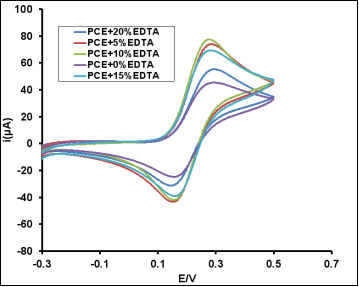
The electrochemical behavior of the carbon paste electrode (CPE) and the EDTA-modified carbon paste electrode (EDTA-CPE) was investigated by cyclic voltammetry using [Fe(CN)₆]4⁻ as a redox probe. Figure 1 displays the voltammograms obtained with both unmodified and EDTA-modified electrodes. A marked increase in the intensities of the anodic and cathodic peaks is observed following modification, indicating enhanced surface conductivity. This enhancement suggests that the presence of EDTA facilitates electron transfer at the electrode/solution interface. These findings are consistent with previous literature reports .
Moreover, the redox peaks appear sharper and more defined after modification, which may indicate favorable chemical interactions between the EDTA embedded in the paste and the redox probe ([Fe(CN)₆]4⁻) in solution. The peak intensity also varies with the proportion of EDTA in the paste, a trend similarly observed by others authors .
Figure 1. Cyclic voltammograms of the EDTA-CPE system at different percentages of EDTA. Electrolyte KCl support 0.1 mol/L containing ([Fe(CN)6]4- 5.10-3 mol/L; electrode Ag/AgCl reference saturated with KCl; scanning rate v=10-60 mV/s.
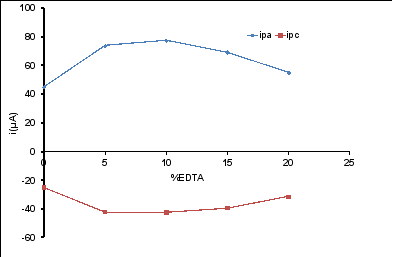
To determine the most effective composition, the influence of the EDTA-to-graphite ratio on the current response was evaluated. Figure 1 presents the cyclic voltammograms for each proportion. The peak current increases with EDTA content up to 10%, then decreases at higher proportions, in some cases falling below the response of the unmodified electrode. This decrease may be attributed to a disruptive effect of excess EDTA on the electrode's surface activity. Such behavior aligns with earlier studies on modified carbon paste electrodes .
The voltammetric responses recorded at various EDTA concentrations allowed identification of the optimal modifier content. The current density data extracted from Figure 1 were used to construct the curve shown in Figure 2. Incorporating 10% EDTA into the graphite powder yielded a peak current density of 77.42 µA, the highest recorded. Thus, 10% EDTA was selected as the optimal composition for the modified electrode (EDTA-CPE) used in subsequent experiments.
Figure 2. Representation of the anodic and cathodic peaks as a function of EDTA percentages.
3.2. Electrochemical Characterization of the EDTA-CPE System
Electrochemical impedance spectroscopy (EIS) and cyclic voltammetry (VC) techniques were used to characterize the bare (PCE) and modified (PCE-EDTA) electrode in a 5 mM [Fe(CN)6]4- solution prepared in 0.1 M KCl.
3.2.1. Cyclic Voltammetry
Cyclic voltammetry is a versatile electrochemical method used to analyze reaction mechanisms and characterize materials by measuring current as a function of a swept potential. In cyclic voltammetry (CV), a variety of electrochemical parameters can be extracted from the recorded curves. However, certain parameters are not always reported, either due to their methodological complexity or their limited relevance to the specific objectives of the study. In the present work, the analysis was deliberately focused on key voltammetric indicators that are directly related to the analytical performance of the sensor such as Ipa (anodic peak current), Ipc (cathodic peak current), ΔEp (peak-to-peak potential separation) and Ipa/Ipc ratio. These parameters were selected because they: provide information on reversibility (via ΔEp), reflect sensitivity and reproducibility (via Ipa and Ipc), and allow for the assessment of the electrochemical stability of the modified electrode. They thus represent the most relevant and practical metrics for a preliminary functional evaluation of the developed sensing platform.
Cyclic voltammetry provides precise information, particularly for reversible systems governed by the Randles-Sevcik equation :
Ip=2.687.105n3/2.A.D1/2.v1/2.C(1)
Where n represents the number of electrons involved in the redox reaction; A represents the electrode area in cm²; v represents the scanning speed in V/s; C represents the concentration of the active species in mol/cm³; D represents the diffusion coefficient in cm²/s. The reaction mechanism is evaluated using the study of the peak potential deflection ΔEp (2) .
Ep=Epa-Epc mV(2)
The value of ΔEp provides information about the reaction mechanism.
Thus:
If ΔEp = 60 mV, the system is rapidly reversible.
If ΔEp > 60 mV, the system is nearly reversible slowly or nearly irreversibly slowly.
From the peak potentials, the formal standard potential of the oxidizing/reducing couple E° is calculated from relation (3) :
E°=(Epa+Epc)/2(3)
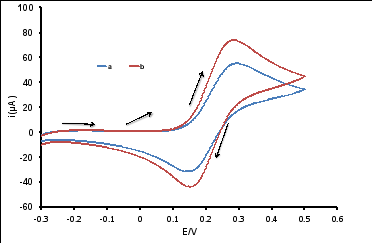
Another key indicator in the analysis of a cyclic voltammogram is the ratio between the anodic and cathodic peak currents: |Ipa/Ipc| . This ratio provides information on transport mechanisms and side reactions. Two cases are possible: (1) a ratio close to 1 indicates a reversible electrochemical reaction (rapid equilibrium); (2) a deviation from 1 suggests the existence of chemical reactions coupled to electron transfer or other complex phenomena at the electrode-solution interface. Figure 3 shows the cyclic voltammetry of PCE (curve a) and EDTA-CPE (curve b).
The voltammogram reveals anodic (Ipa) and cathodic (Ipc) current peaks, corresponding to potentials Epa and Epc, respectively. The presence of these peaks indicates that the redox reaction proceeds efficiently at the surface of the electrode material, confirming the electrochemical activity of the carbon paste. Any electrode material in contact with the ferri/ferrocyanide couple should produce a similar curve if it is electrochemically active. The current and potential values were used to determine the peak potentials and the current ratio. The results are presented in Table 1.
Table 1. Electrical values of the working electrode in the presence of the Ferro/Ferricyanide couple in cyclic voltammetry (CV).

Working Electrodes

∆E_P

|I_Pa⁄I_Pc |

E° (V)

CPE

0.144

1.77

0.222

EDTA-CPE

0.128

1.70

0.218

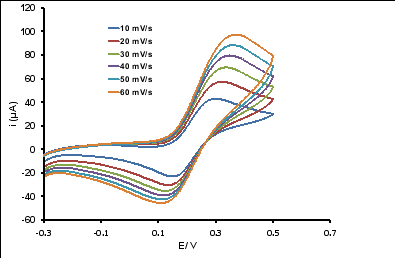
The effect of scanning speed on the cyclic voltametric response of the 10% EDTA-Modified Carbon Paste Electrode (EDTA-CPE) was also studied. Figure 4 shows the cyclic voltammograms recorded with a 10% EDTA-modified carbon paste electrode (EDTA-CPE) at scanning speeds between 0.01 and 0.06 V/s, within a potential range of −0.3 to 0.7 V. At each speed, the voltammograms maintain a similar shape, reflecting the stability of the electrochemical system under the applied experimental conditions. Furthermore, a progressive increase in anodic and cathodic currents is observed with increasing scanning speed, which is consistent with the trends generally observed in controlled diffusion systems .
Table 2 summarizes the data extracted from cyclic voltammograms obtained with a carbon paste electrode modified with 10% EDTA, for scan rates between 0.01 and 0.06 V/s. It shows that the potential difference between the anodic and cathodic peaks (ΔEp = Epa ‐ Epc) increases with the scan rate (ν), and that the potentials Epa and Epc also vary with this rate. This evolution suggests a relatively slow electrochemical process, characterized by non-ideal electron transfer kinetics.
Table 2. Experimental data drawn from the cyclic voltammograms of the CPE modified with 10% of EDTA. Electrolyte support KCl 0.1 mol/L containing [Fe(CN)6]4- 5.10-3 mol/L, Ag/AgCl reference electrode saturated with KCl; scanning rate v=10-60 mV/s.

Working Electrodes

v (V/s)

Epa (V)

Epc (V)

ΔE (mV)

|I_Pa⁄I_Pc |

E^° (V)

PCE-EDTA

0.01

0.292

0.15

142

1.864

0.221

0.02

0.318

0.13

188

1.889

0.224

0.03

0.332

0.126

206

1.973

0.229

0.04

0.338

0.13

208

1.896

0.128

0.05

0.346

0.12

226

1.939

0.229

0.06

0.362

0.114

248

2.133

0.238

Analysis of the Tables 1 and 2 reveal different values for E°, ∆Ep, and the ratio |Ipa/Ipc|. This initial observation suggests that the electrode materials influence the electrochemical activity of the ferri/ferrocyanide couple. The ratios |Ipa/Ipc| are different from 1 (Tables 1 and 2), thus confirming the slowness of the system. The difference between the Ipa and Ipc (Table 1) values could also be explained by the modification of surface properties due to various phenomena occurring on the surface of the EDTA-modified carbon paste electrodes.
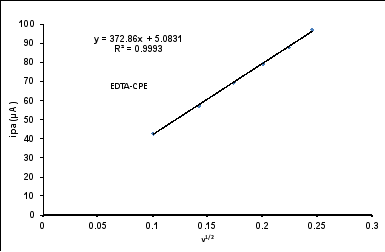
Furthermore, the relationship between the scan speed and the intensity of the anodic peak was established in order to define the electrochemical process at the PCE-EDTA/Solution interface. Figure 5 shows the curve Ipa = f(v1/2) for EDTA-modified carbon paste electrodes.
The Ipa = f(ν1/2) curves for the PCE-EDTA system exhibit a linear variation (R² > 0.9993) in the peak anodic current intensity as a function of ν1/2 (Figure 5).
Figure 3. Cyclic voltammograms of PCE (a) and EDTA-CPE (b). Electrolyte KCl support 0.1 mol/L containing ([Fe(CN)6]4- 5.10-3 mol/L; electrode Ag/AgCl reference saturated with KCl; scanning rate v=50 mV/s.
Figure 4. Cyclic voltammogramm of EDTA-CPE. Electrolyte KCl support 0.1 mol/L containing ([Fe(CN)6]4- 5.10-3 mol/L; electrode Ag/AgCl reference saturated with KCl; scanning rate v=10-60 mV/s.
Figure 5. Curve of Ipa=f(v1/2) of EDTA-CPE. Electrolyte KCl support 0.1 mol/L containing ([Fe(CN)6]4- 5.10-3 mol/L; electrode Ag/AgCl reference saturated with KCl; scanning rate v=10-60 mV/s.
3.2.2. Electrochemical Impedance Spectroscopy
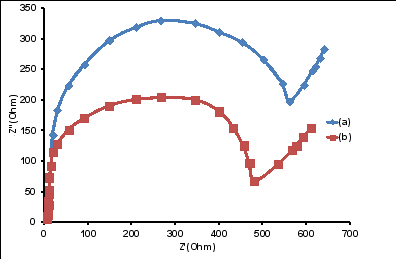
EIS is a basic tool for determining the electrochemical properties of the electrode surface/interface and can provide specific information on impedance variations during the electrode modification process. The results are presented as Nyquist plots, where the real (Z') and imaginary (Z'') components of the impedance are plotted on the x- and y-axes, respectively. The Nyquist curves for CPE (curve a) and EDTA-CPE (curve b) comprised two sections: a straight line of approximately 45°C in the low-frequency region indicating mass transfer by diffusion of electroactive species and a semicircle of different diameter in the high-frequency region representing the surface electron exchange environment .
Figure 6. Nyquist plots of CPE (a) and EDTA-CPE (b). Electrolyte KCl support 0.1 mol/L containing ([Fe(CN)6]4- 5.10-3 mol/L; electrode Ag/AgCl reference saturated with KCl at frequency range: 0.01- l00,000 Hz applied potential : 0.2 V, and amplitude: 0.01 V.
4. Discussion
The analysis of the potential difference (ΔEp) obtained for all systems shows values exceeding 60 mV , indicating that the ferri/ferrocyanide redox reaction is either slow, quasi-reversible, or nearly irreversible. Such kinetic slowness suggests a significant resistance to electron flow within the electrode material. The ΔEp value is a useful parameter for comparing the reaction mechanisms across different electrodes—lower ΔEp values imply improved conductivity and better cohesion within the electrode matrix. As shown in the data, the carbon paste electrode modified with 10% EDTA exhibits a ΔEp of 128 mV, compared to 144 mV for the unmodified CPE, confirming a more efficient electron transfer at the surface of the modified electrode. This reduction in ΔEp reflects the enhanced electrochemical performance due to EDTA incorporation . The current peak ratio |Ipa/Ipc| varies between systems and deviates from unity, implying that the electron transfer kinetics differ depending on the electrode composition. A ratio greater than 1 suggests that the anodic current exceeds the cathodic one, while a ratio below 1 implies the opposite. In both CPE and CPE-EDTA systems, the ratio exceeds 1, indicating a dominant oxidation process and suggesting that electron transfer is coupled with mass transport phenomena. Additionally, Table 1 presents varying values of the apparent standard potential (E°), which highlights the influence of the electrode modifier on the redox system. Although values remain close to that of the bare CPE, slight shifts point to changes in the interfacial environment induced by EDTA. Finally, the linear relationship between the anodic peak current (Ipa) and the square root of the scan rate suggests that the electrochemical process is diffusion-controlled, governed by the transport of electroactive species to the electrode interface.
Electrochemical impedance spectroscopy (EIS) was employed alongside cyclic voltammetry (CV) to provide a more comprehensive understanding of the interfacial properties of the EDTA-modified carbon paste electrode (EDTA-CPE) and the associated charge transfer processes.
In these plots, the semicircular shape observed at high frequencies reflects the charge transfer resistance (Rct), a critical parameter indicative of the ease with which electrons are exchanged at the electrode/electrolyte interface. As shown in Figure 6, the bare carbon paste electrode exhibits an Rct of 560 Ω (curve a). Upon modification with 10% EDTA, the Rct decreases to 480 Ω (curve b), indicating enhanced charge transfer kinetics due to the presence of EDTA. Similar results have been reported by other authors . This improvement in interfacial conductivity is in good agreement with the CV data, particularly the observed decrease in peak potential separation (ΔEp), which suggests improved electrochemical reversibility. The consistency between EIS and CV results reinforces the conclusion that EDTA functionalization enhances the redox behavior of the electrode, likely by facilitating complexation with target metal ions and promoting faster electron transfer at the interface.
5. Conclusions
The study of the electrochemical behavior of the ferri/ferrocyanide redox couple on EDTA-modified carbon paste electrodes has led to a better understanding of the electron transfer properties at the surface of these electrodes. Results obtained by cyclic voltammetry showed that the introduction of 10% EDTA into the carbon paste improves the electrochemical response, notably by decreasing the peak potential difference (ΔEp) and increasing the anodic peak current, indicating improved reversibility of the redox system. This improvement is attributed to the presence of EDTA complexing groups that promote interaction between the electrode and the species in solution. These electrochemical performances enhance the potential of this modified electrode for sensitive and selective chromium (Cr(III,VI)) detection. These results provide a promising basis for the development of efficient electrochemical sensors, particularly for environmental monitoring of water contaminated by heavy metals. Further studies are underway to evaluate the analytical performance of this electrode under real conditions of chromium Cr(III, VI) detection.
Abbreviations

EDTA

EthyleneDiamineTetraacetic Acid

CPE

Carbon Paste Electrode

CV

Cyclic Voltammetry

EIS

Electrochemical Impedance Spectroscopy

Ipa

Anodic Peak Intensity

Ipc

Cathodic Peak Intensity

Epa

Anodic Peak Potential

Epc

Cathodic Peak Potential

Author Contributions
Ollé Rodrigue Kam: Conceptualization, Investigation, Methodology, Validation, Writing – original draft, Writing – review & editing
Abdoulkadri Ayouba Mahamane: Conceptualization, Formal Analysis, Validation, Methodology, Supervision, Writing – review & editing
Corneille Bakouan: Conceptualization, Formal Analysis, Methodology, Supervision, Writing – review & editing
Boubié Guel: Conceptualization, Funding Acquisition, Methodology, Supervision, Writing – review & editing
Funding
The authors declare no funds related to the writing of the article.
Conflicts of Interest
Authors have declared that no competing interests exist.
References
[1] Zaib, M., Athar, M. M., Saeed, A., Farooq, U. Electrochemical determination of inorganic mercury and arsenic--A review. Biosens Bioelectron. 2015, 74, 895-908.
[2] Bhanjana, G., Dilbaghi, N., Kumar, R., Kumar, S. Zinc Oxide Quantum Dots as Efficient Electron Mediator for Ultrasensitive and Selective Electrochemical Sensing of Mercury. Electrochimica Acta. 2015, 178, 361-367.
[3] Ferrari, A. G. M., Crapnell, R. D., Adarakatti, P. S., Suma, B. P, Banks, C. E. Electroanalytical overview: The detection of chromium. Sensors and Actuators Reports. 2022, 4, 2666-0539,
[4] Wang, J., Lei, S., Sun, T., Han, P. Adsorptive removal of Cr (III)-EDTA chelate from an aqueous solution by magnetic mesoporous silica microspheres. Water Sci Technol. 2023, 87(3), 571-583.
[5] Zhang, Y., Chen, X., Liu, J., Yang, F. Detection of Chromium (VI) in Water Using an Electrochemical Sensor Based on Ketjen Black-Modified Carbon Cloth. Nature Environment and Pollution Technology. 2021, 20(2), 775-783.
[6] Svancara, I., Kalcher, K., Walcarius, A., Vytras, K. Carbon paste electrodes in environmental analysis. 1st Edition. 2012, p 666.
[7] Teng, Z., Hongying, Lv., Wang, L., Liu, L., Wang, C., Wang, G. Voltammetric Sensor Modified by EDTA-immobilized Graphene-like Carbon Nitride Nanosheets: Preparation, Characterization and Selective Determination of Ultra-Trace Pb (II) in Water Samples. Electrochimica Acta. 2016, 212, 722-733.
[8] Balaskaa F., Bencheikh-Lehocinea, M, Chikhia, M. Meniaia., A-H,. Bouledjouidja, A. Experimental study and simulation of complexation reaction of chromium by EDTA for its recovery by ultrafiltration. Energy Procedia. 2012, 19, 249-258.
[9] Koç. Y., Morali, U., Erol, S., Avci, H. Investigation of electrochemical behavior of potassium ferricyanide/ferrocyanide redox probes on screen printed carbon electrode through cyclic voltammetry and electrochemical impedance spectroscopy. Turk J Chem. 2021, 45(6), 1895-1915.
[10] N'dri, S. R., Coulibaly M., Yao N. A, Bamba D, & Zoro G E., Redox Characterization of the Ferri/Ferrocyanide System on the P-type Silicon Paste Electrode for Biosensor Application. Journal of Materials Science Research and Reviews. 2022, 5(3), 366-374.
[11] Sherigara, B. S.; Shivaraj, Y.; Ronald J. M.; Satpati A. K. Simultaneous determination of lead, copper and cadmium onto mercury film supported on wax impregnated carbon paste electrode: Assessment of quantification procedures by anodic stripping voltammetry. Electrochimica Acta 2007, 52, 3137-142.
[12] Cassidy, J. F.; de Carvalho, R. C.; Betts, A. J. Use of Inner/Outer Sphere Terminology in Electrochemistry—A Hexacyanoferrate II/III Case Study. Electrochem 2023, 4, 313-349.
[13] Touzara, S., Amlil, A., Saâdane, H., Laghlimi, C., Chtaini A. EDTA-Modified Carbon Paste Composite for Electrochemical Determination of Pb(II) Ions. Journal of Material Sciences & Engineering. 2019, 8(6), 1-5.
[14] Moges, A., Dawit, M., Turbale, M., Amare, M. EDTA salt modified carbon paste electrode for square wave voltammetric determination of theophylline in pharmaceutical tablet formulation. PLoS One. 2022, 17(6), 1-15.
[15] El Mastour J, El Qouatli SE, Zaroual A and Chtaini A, Electrochemical Chelation and Reduction of Nitrate Ion on EDTA Modified Carbon Paste Electrode. Journal of Material Sciences & Engineering. 2018, 7(2), 1-5.
[16] Sanou, A., Coulibaly, M., N’dri, S. R., Tămaș, T. L., Bizo, L., Frentiu, T., & Turdean, G. L. Raw clay material-based modified carbon paste electrodes for sensitive heavy metal detection in drinking water. Journal of Materials Science. 2024, 1-17.
[17] Moutcine, A., Chtaini, A. Electrochemical determination of trace mercury in water sample using EDTA-CPE modified electrode. Sens. Bio-sensing Res. 2018, 17, 30–5.
[18] Randles. J. E. A cathode ray polarograph. Part II, The current-voltage curves. Transactions of the Faraday Society. 1948, 44, 327-338.
[19] Belqat, B., & Belcadi, S., Electrochemical behaviour of fer rocene, perylene and tetracene in an electrolytically bound carbon paste electrode in water-phosphoric acid mixtures. Comptes Rendus de l'Académie des Sciences-Series IIC-Chemistry. 2001, 4(12), 933-939.
[20] Tcheumia, H. L., Tonle, I. K., Ngamenia, E., Walcariusc, A.. Electrochemical analysis of methylparathion pesticide by a gemini surfactant‐intercalated clay‐modified electrode. Talanta. 2010, 81, 972–97.
[21] Hu C. and S. Hu. Electrochemical characterization of cetyltrimethyl ammonium bromide modified carbon paste electrode and the application in the immobilization of DNA. Electrochimica Acta 2004, 49(3), 405–412.
[22] Pournaghi‐Azar, M. H. and H. Dastangoo. Differential pulse anodic stripping voltammetry of copper in dichloromethane: Application to the analysis of human hair. Anal. Chim. Acta. 2000, 405(1-4), 135–144.
[23] Raghu P., Madhusudana R., T., Reddaiah K.., Jaidev L. R. and G. Narasimha. A novel electrochemical biosensor based on horseradish peroxidase immobilized on Ag‐nanoparticles/poly(l‐arginine) modified carbon paste electrode toward the determination of pyrogallol/hydroquinone. Enzyme Microb. Technl. 2014, 57, 8-15.
[24] Amani-Beni Z, Nezamzadeh-Ejhieh A. NiO nanoparticles modified carbon paste electrode as a novel sulfasalazine sensor. Anal. Chim. Acta 2018; 1031, 47–59.
[25] Ali, M. and A. Derakhshan. Boehmite nano particle modified carbon paste electrode for determination of piroxicam. Sensors Actuators B. Chem. 2014, 201, 378–386.
Cite This Article
  • APA Style

    Kam, O. R., Mahamane, A. A., Bakouan, C., Guel, B. (2026). Electrochemical Investigation of the Ferri/Ferrocyanide Redox Couple on EDTA-Carbon Paste Electrodes. Science Journal of Analytical Chemistry, 14(1), 1-9. https://doi.org/10.11648/j.sjac.20261401.11

    Copy | Download

    ACS Style

    Kam, O. R.; Mahamane, A. A.; Bakouan, C.; Guel, B. Electrochemical Investigation of the Ferri/Ferrocyanide Redox Couple on EDTA-Carbon Paste Electrodes. Sci. J. Anal. Chem. 2026, 14(1), 1-9. doi: 10.11648/j.sjac.20261401.11

    Copy | Download

    AMA Style

    Kam OR, Mahamane AA, Bakouan C, Guel B. Electrochemical Investigation of the Ferri/Ferrocyanide Redox Couple on EDTA-Carbon Paste Electrodes. Sci J Anal Chem. 2026;14(1):1-9. doi: 10.11648/j.sjac.20261401.11

    Copy | Download

  • @article{10.11648/j.sjac.20261401.11,
      author = {Ollé Rodrigue Kam and Abdoulkadri Ayouba Mahamane and Corneille Bakouan and Boubié Guel},
      title = {Electrochemical Investigation of the Ferri/Ferrocyanide Redox Couple on EDTA-Carbon Paste Electrodes},
      journal = {Science Journal of Analytical Chemistry},
      volume = {14},
      number = {1},
      pages = {1-9},
      doi = {10.11648/j.sjac.20261401.11},
      url = {https://doi.org/10.11648/j.sjac.20261401.11},
      eprint = {https://article.sciencepublishinggroup.com/pdf/10.11648.j.sjac.20261401.11},
      abstract = {This study focuses on evaluating the electrochemical behavior of the ferri/ferrocyanide redox couple [Fe(CN)₆3-/Fe(CN)₆4-] on EDTA-modified carbon paste electrodes, with the aim of developing a sensitive electrochemical sensor for the detection of trivalent and hexavalent chromium Cr(III,VI). EDTA, a complexing agent well known for its strong affinity for metal ions, was incorporated at a concentration of 10% in the carbon paste to enhance the electrode's ion recognition properties. Electrochemical characterization was performed by cyclic voltammetry in the presence of the ferri/ferrocyanide redox couple, used as a probe to assess electron transfer properties. Electrochemical parameters, including the peak potential difference (ΔEp), the anodic and cathodic peak currents (Ipa, Ipc), and their ratio, demonstrated the improved redox behavior and sensitivity of the modified electrode. The observed improvement is likely due to the complexing functional groups of EDTA, which facilitate stronger interactions between the modified electrode surface and the redox species in solution. Electrochemical impedance spectroscopy supports the voltammetric findings, confirming enhanced charge transfer kinetics at the surface of the modified electrode. The results confirm the potential of this configuration as an effective platform for developing reliable and selective electrochemical sensors for detecting Cr(III,VI) in aqueous media. By studying the electrical quantities ΔEp, the formal standard potential E°, and the Ipa/Ipc current ratio, the developed electrochemical sensors can be optimized.},
     year = {2026}
    }
    

    Copy | Download

  • TY  - JOUR
    T1  - Electrochemical Investigation of the Ferri/Ferrocyanide Redox Couple on EDTA-Carbon Paste Electrodes
    AU  - Ollé Rodrigue Kam
    AU  - Abdoulkadri Ayouba Mahamane
    AU  - Corneille Bakouan
    AU  - Boubié Guel
    Y1  - 2026/01/15
    PY  - 2026
    N1  - https://doi.org/10.11648/j.sjac.20261401.11
    DO  - 10.11648/j.sjac.20261401.11
    T2  - Science Journal of Analytical Chemistry
    JF  - Science Journal of Analytical Chemistry
    JO  - Science Journal of Analytical Chemistry
    SP  - 1
    EP  - 9
    PB  - Science Publishing Group
    SN  - 2376-8053
    UR  - https://doi.org/10.11648/j.sjac.20261401.11
    AB  - This study focuses on evaluating the electrochemical behavior of the ferri/ferrocyanide redox couple [Fe(CN)₆3-/Fe(CN)₆4-] on EDTA-modified carbon paste electrodes, with the aim of developing a sensitive electrochemical sensor for the detection of trivalent and hexavalent chromium Cr(III,VI). EDTA, a complexing agent well known for its strong affinity for metal ions, was incorporated at a concentration of 10% in the carbon paste to enhance the electrode's ion recognition properties. Electrochemical characterization was performed by cyclic voltammetry in the presence of the ferri/ferrocyanide redox couple, used as a probe to assess electron transfer properties. Electrochemical parameters, including the peak potential difference (ΔEp), the anodic and cathodic peak currents (Ipa, Ipc), and their ratio, demonstrated the improved redox behavior and sensitivity of the modified electrode. The observed improvement is likely due to the complexing functional groups of EDTA, which facilitate stronger interactions between the modified electrode surface and the redox species in solution. Electrochemical impedance spectroscopy supports the voltammetric findings, confirming enhanced charge transfer kinetics at the surface of the modified electrode. The results confirm the potential of this configuration as an effective platform for developing reliable and selective electrochemical sensors for detecting Cr(III,VI) in aqueous media. By studying the electrical quantities ΔEp, the formal standard potential E°, and the Ipa/Ipc current ratio, the developed electrochemical sensors can be optimized.
    VL  - 14
    IS  - 1
    ER  - 

    Copy | Download

Author Information
  • Department of Physics and Chemistry, Banfora University Center, Banfora, Burkina Faso

    Research Fields: Physical chemistry, Electrochemistry.

  • Chemistry Department, Abdou Moumouni University, Niamey, Niger

    Research Fields: Physical chemistry, Electrochemistry.

  • Department of Physics and Chemistry, Lédéa Bernard Ouedraogo University, Ouahigouya, Burkina Faso

    Research Fields: Materials chemistry.

  • Chemistry Department, Joseph KI-ZERBO University, Ouagadougou, Burkina Faso

    Research Fields: Physical chemistry, Electrochemistry.
  • Table 1

    Table 1. Electrical values of the working electrode in the presence of the Ferro/Ferricyanide couple in cyclic voltammetry (CV).

  • Table 2

    Table 2. Experimental data drawn from the cyclic voltammograms of the CPE modified with 10% of EDTA. Electrolyte support KCl 0.1 mol/L containing [Fe(CN)6]4- 5.10-3 mol/L, Ag/AgCl reference electrode saturated with KCl; scanning rate v=10-60 mV/s.